
|
Flick through your TV channels on any given day and it’s highly likely you’ll stumble upon an episode of Dad’s Army, Only Fools and Horses or Porridge – or sometimes all three of them, back to back. Timeless sitcoms like these have such clearly defined characters, clever plots and familiar settings that they seem to appeal to all generations, and will probably go on doing so forever.
But is there anything of the same quality being written today? Is there any show that will resonate quite as far into the future – and earn as many royalties for its creators in their dotage?! I‘ve been prompted to ponder these questions following the sad death last month of the great Jimmy Perry, who created and wrote Dad’s Army, It Ain’t Half Hot Mum and Hi-de-Hi along with his writing partner/producer David Croft. I was honoured to be invited to be a judge at the 1996 British Comedy Awards alongside not just the charming Jimmy but also the fabulously talented John Sullivan (Citizen Smith, Only Fools and Horses). As a relative rookie at the time, writing comedy drama for the German market, it was quite a daunting and surreal experience. These guys were comedy giants but, as I was to discover, they were also ordinary human beings, not unlike me! I took the opportunity to pick their brains about writing and get to know them a bit better as actual people. They were both an absolute inspiration. Without a doubt this was the best unpaid job I’ve ever had. Sadly both Jimmy and John are no longer with us, but their legacies live on. When I look at the current crop of “sitcoms” on TV I am not sure there’s anything that quite falls into the same category as their classic shows. Viewing patterns have changed so much. Who can remember the last time they sat down with three generations of their family to watch anything other than Strictly or Bake Off? This means there’s a big sitcom-shaped gap in the market - and if you’re an aspiring comedy writer who’d like to relax in retirement as the royalties flood in, you could potentially fill it. My advice would be to take every opportunity you can to learn from the greats: where do they get their ideas from; what makes an idea work; how do they go about their writing process; how have they sold their projects? Talking to ordinary people who also happen to be highly successful comedy writers can inform and inspire a whole career. Trust me, I’m a writer. Anji Loman Field (www.anjilomanfield.com) is co-hosting an event on 16th November: MEET AWARD-WINNING COMEDY WRITING DUO MARKS & GRAN Inspirational comedy writing partners Laurence Marks and Maurice Gran (Birds of a Feather, The New Statesman, Goodnight Sweetheart) share the secrets of their success with Nicola Quilter. After a Q&A session, we will be running an optional Speed Dating For Co-Writers session. Meet other like-minded writers, test your compatibility with a range of potential writing partners, all of whom are potentially looking to collaborate. DATE: Weds 16 November TIME: 6.30-8.30pm (followed by Euroscript Christmas Drinks and Launch of the Euroscript screenwriting Competition 2017) VENUE: THE DRIVER, 2-4 Wharfdale Road, London N1 9RY PRICE: £10 to cover room hire and a FREE DRINK (book here)
0 Comments
Ian Long was Euroscript’s representative at Riga International Film Festival in late October 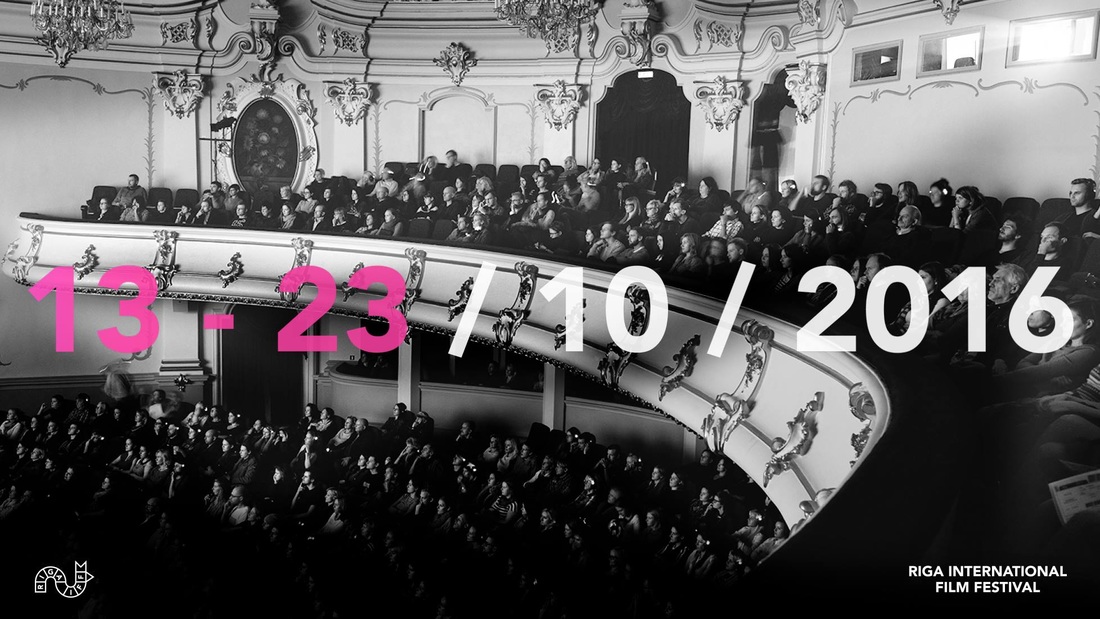 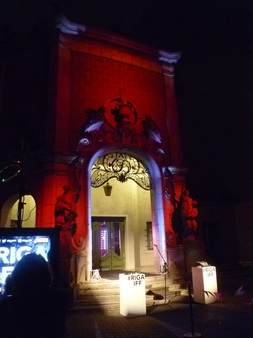 The Splendid Palace cinema, where the festival was based The Splendid Palace cinema, where the festival was based Euroscript was delighted to be part of the Riga International Film Festival and European Script Meeting. It was a great opportunity to meet European writers, share ideas and pass on useful thoughts; and if that wasn't enough, much of the time was spent in and around the rococo beauty of the Splendid Palace Cinema - possibly the oldest purpose-built picture house still operating in Europe. European Script Meeting The Script Meeting’s remit is very generous. It’s simply a place where screenwriters, producers, directors and studio representatives can bring their projects, talk about ideas, and begin collaborations on stories in a relaxed atmosphere, with no strings attached. As we joined a select group of script consultants to meet the writers, we were keen to see what we’d learn of current narrative trends and opinions. After all, the delegates were from all over Europe: Croatia, Macedonia, Georgia, Hungary, Germany, Lithuania and the Czech Republic, as well as from Latvia itself. The projects’ subject-matter was encouragingly wide: a drama about the impact of hip hop culture on Lithuania; contemporary comedy merging with commedia del arte in an Italian palazzo; a story which investigates the dream-world of coma and finds a universe of meaning within it... The writers were friendly and engaged; many deep discussions took place, and new exciting connections were made. So far, so fascinating. But what would happen on the Sunday, when we were scheduled to take our place in the spotlight, presenting our own writing workshop? 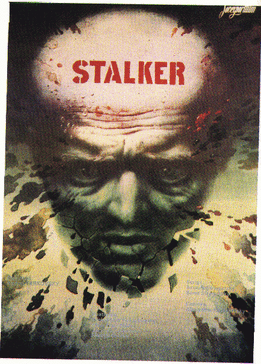 Mixing Genres, ‘Heightened’ Genres, and Speculative Fiction Genres are mutating and blending as never before, and it’s notable that many of the European films that make international waves are in heightened or fantasy-inflected genres – such as LET THE RIGHT ONE IN (Tomas Alfredson, Sweden, 2008), TROLLHUNTER (André Øvredal, Norway, 2010) and UNDER THE SKIN (Jonathan Glazer, UK, 2014). With these things in mind, Euroscript took the floor on Sunday morning in a semicircular auditorium beneath the Splendid Palace to present a four-hour workshop. Having somehow resisted the , we were in a position to outline the ways in which genres can mix and how Science (or, better, Speculative) Fiction can creatively address themes which some may associate only with Social Drama. Some reactions to the talk revealed that even some talented and sophisticated screenwriters from certain cinema cultures are missing out on the potential of ‘genre’ writing to put ideas onscreen in vivid and cinematic ways. We reminded the audience that significant filmmakers like Rainer Werner Fassbinder, Stanley Kubrick, Andrzej Żuławski, Jean Luc Godard have made important contributions to the Science Fiction genre – and that films like SOLARIS and STALKER are outstanding genre works as well as intellectual and cinematic landmarks. So the answer to the title question is - yes, Tarkovsky definitely did do Science Fiction! In the afternoon, screenwriter and script doctor Jimmy Karlsson gave a valuable workshop reminding us of the screenwriting ‘basics’ – something which is always welcome to the most experienced writers and script consultants. All in all, the weekend was a great opportunity to meet new friends and colleagues and to compare film cultures and approaches. And along the way, we got the chance to explore a fascinating city and sample the warm hospitality of the Latvian script contingent, led by Amanda Boka and her team. You can find more about Euroscript's consultancy services here... and more about Ian Long's genre workshops here. The Riga International Film Festival website can be found here, and more details about the European Script Meeting here. You can also follow them on Facebook. 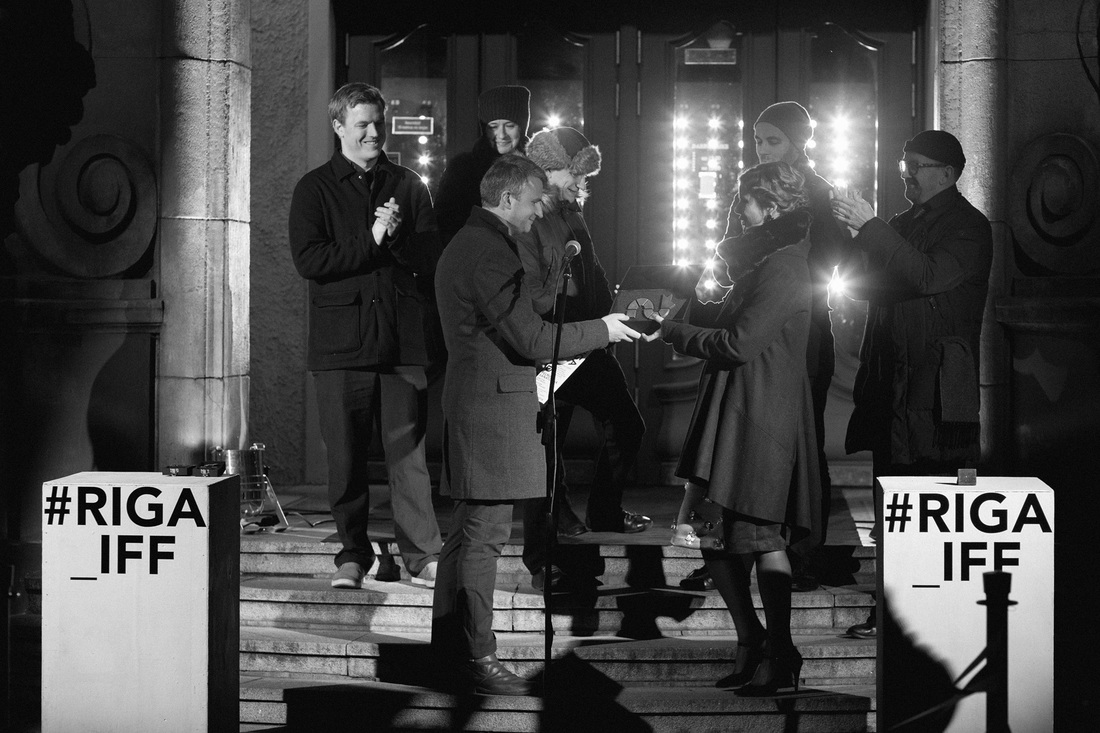 Winning director Davis Simanis accepts the #Riga IFF AWARD for his film Pelnu Sanatorija 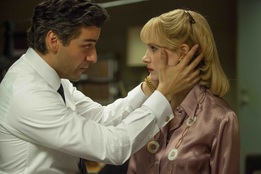 Charles Harris As I said in previous articles, I suggest approaching a second draft screenplay as a number of mini-drafts, each focusing on a different aspect. After revising structure and character, we're now ready to turn to the individual scenes. The advantage of this approach is that you don't have to worry about details when you're still working on the larger picture. It would be pointless, for example, to spend time polishing a scene that may disappear if you later changed the overall structure or revised a key character. The Scene Draft For this draft, you work through the script scene by scene, starting with the first. Read each through a number of times. Look for where the scene works best and where it falters. Is it too long - or too short? Does it work dramatically or is it flat? Good scenes are the powerhouse of your script - but poor scenes will suck out the energy! Watch out especially for scenes that are "setting things up". These are very off-putting, both to a reader and to the ultimate audience. If you find a Setting-Up scene - and you'll doubtless find many - ask yourself if you can give it a dramatic point. Can you bring out some element of conflict or put at least obstacles in the protagonist's way? 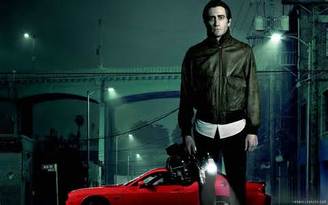 Can you build the emotion - whether comedy, tragedy or thriller? If not, then you'll probably need to axe the scene entirely and leave the information till later - or cut it out entirely.
Writers often become over-anxious about telling the audience things. Questions are more important than answers. Build up questions in the viewers' minds and they will be drawn into the story - and want to find out what happens next. Short and sweet Most early draft scenes will need to to be shortened, often dramatically. A good movie scene is usually short and contains a single dramatic beat - that is to say: one dramatic change. For example, at the start of the scene, the heroine may be desperately trying to find a lost key, by the end she's succeeded or failed. There may be a few major scenes that contain more beats, but keep them to a minimum. TV scenes may contain more than one beat, as there is generally less money for sets and locations, but even so the beats will be limited. Otherwise your script risks turning into a stage play. Be ruthless. Find the heart of the scene and get to it quickly, cutting out any preamble. The best scenes dive straight to the heat of the action. And end rapidly - so eradicate any winding down. All those "hellos" and "goodbyes" should go into the trash bin. You'll be surprised how much tighter and more energised your script becomes. Who's in charge? Now, decide who the protagonist of the scene is. It's usually the protagonist of the story as a whole, but not always. Make sure that she pushes the scene forwards, taking action to overcome obstacles. This may mean giving her a goal in the scene (which will normally involve planting this in a previous scene). Or it could mean adding new obstacles. Or ensuring that she takes action and doesn't leave it to someone else. Variety is the spice of life Next look at variety and pacing. Ideally each scene should be different from the scenes before and after - either faster or slower or funnier or more tense, etc. As with characters, in the last article, look to see if you have two or more scenes performing the same function. You'll often find that you've written a number of quite different scenes that essentially do the same thing. Three scenes which show the protagonist saving a dog, defending a work colleague and giving money to a Big Issue saleswoman may all be there to show his positive side. Decide which is the most interesting and delete the rest. And just as some characters work better when combined into one, the same can apply to half-decent scenes. Often, one really strong scene can emerge from elements from a number of scenes that weren't working on their own. Many layers make scenes work Once a scene has been trimmed down and possibly combined with others, look finally at layering in some more elements to make it even better. Good scenes are generally multi-layered. While pushing the story forwards, they surreptitiously slip in other material that can, for example, set up future issues, deepen character or enrich the theme. Early in the film Nightcrawler, petty thief Lou comes across a burning car on a freeway. Cops are trying to pull the driver out. As Lou watches, intrigued, a TV news crew arrives to film the incident and he asks a few questions. It's a simple scene, but does everything we've seen above. It starts the moment he pulls his car over and gets out. Immediately we are plunged into the action of the attempted rescue. He wants to know how the TV crew work but the script provides obstacles, making the cameramen preoccupied and brusque in their answers. It is faster paced than the scene before and after. And despite the simplicity of the action, it provides many deeper layers - developing Lou's character, setting up the idea of filming death and injury for TV, his future competitors and the mechanisms and the ethics involved. (You can read the screenplay here - the freeway scene starts on page 4). Focus Whereas I suggested writing the first draft quickly, jumping over any gaps, this fourth mini-draft should be painstaking and focused, ensuring that each scene is structured in the best possible way. Once you've done that for every scene in the script, you can move on to the dialogue and description, which we'll be dealing with in mini-drafts five and six... <Previous article Next article> Charles Harris new book Jaws in Space: Powerful Pitching for Film and TV was published last month by Creative Essentials and is already recommended reading on MA courses. You can buy it here and get the e-book version included for free. by Ian Long David Robert Mitchell's 2014 film "It Follows" appealed to an audience well beyond 'genre' fans (see the endless blog posts and Youtube clips interpreting the story as evidence). But why did this particular film raise so much interest? And what can writers working in Horror (and other genres) learn from it?  The story centres on a young woman (Jay) and her group of friends, who are menaced by a relentless, murderous, shape-shifting threat. In terms of genre, then, it's essentially a "Teen Slasher" film. In these films, groups of young people are menaced by monsters, dying one by one in horrific circumstances. Characterisation is fairly thin, and the first to go is often a sexually active girl (the films tend to conform to a specific moral code). Let's look at what opened this film up to a wider audience.
What does this tell us about It Follows?
It's useful to think of films in terms of style and tone as well as genre, and these elements suggest that, as well as Horror, It Follows is an Arthouse film. Arthouse/Indie Style
And maybe we're more ready to accept 'fantasy' storylines when they're presented in these terms? Let The Right One In - a precursor It Follows took its cue from Swedish arthouse vampire film Let The Right One In, acknowledging the debt by staging its climax in a swimming-pool, like the earlier film. In both cases, the filmmakers took a long, hard look at their genre and asked which elements need to remain, and which have become stale conventions which should be ditched. All filmmakers need to do something similar. Conclusion - the Joys of Arthouse Arthouse is cheap, intelligent, critically attractive, and can punch far above its weight in terms of international acclaim. It actively embraces 'foreign' (non-English language) films, opening the door to recent Arthouse Horrors like A Girl Walks Home Alone At Night, Troll Hunter, Let The Right One In, etc. Giving your story an Arthouse twist should make you think through its ingredients in a very rigorous way. SPOILER ALERT: and, despite having early sex scene, Jay isn't singled out for narrative punishment - she's still alive at the end of the film. LEARN MORE ABOUT REFRESHING YOUR HORROR WRITING AT MY WORKSHOP - LONDON, OCTOBER 29 Click here to read about it.  By Charles Harris So far, we've developed an idea as far as first draft and in the last article we began to revise it - looking at structure. Now is the time to go back and look more thoroughly at character. The character redraft is a crucial one. Of course, you've been learning about your characters all along - finding out what makes them interesting, credible and engaging. However, in the first draft it was important to let the imagination flow, without too much constraint. As a result, there will be areas that now need to be strengthened and straightened out. The character edit Start with your protagonist.
Read through the script focusing only on her. At this point in the process, she will almost certainly be too passive, reacting to events rather than pushing the story forwards herself. So the most urgent task will be to ensure she's as active as possible. If someone opens a door for her, make her open the door herself. Or, at least, insist that it's opened. If someone discovers a crucial clue, see if she can't discover it instead. This is her story. She must drive it forwards. Dealing with her flaws Next, is she growing and learning? Focus on her flaws and ensure that she grapples with them. Unless your story is a noir, a satire or an adventure story, the power of your script will depend on her personal character growth, scene by scene. Of course, this shouldn't be linear: we all have set backs from time to time. And it shouldn't be clichéd. Whatever the genre, you want your characters to be original and full of surprise. Complex and contradictory The third step is to look at how rounded her character can be. When first sketching out the story, your protagonist will probably be fairly simply developed. Perhaps a little two-dimensional. Now is the time to add some more complexity. In addition to her flaws, she should have strengths. Otherwise, why should we care about her? What is she good at? What positive traits could she show? Then there's the way she likes to present herself to the world. Her fears are also important. What is she most afraid of in life? And her darker side: what less admirable things would she be capable of doing, if pushed to the limit? Good characters have a range of traits, some of them contradictory. This adds to the credibility of the story, and also gives her the capacity to surprise us and keep us watching. Using subplots to develop character Some of her traits won't necessarily be visible when she's engaged in the main story, but may only come out when confronted by different characters, perhaps in subplots. A detective, for example, may not be able to show her more human side at work, but only when trying to help her small son cope with moving to a new school. The other roles Once I've thoroughly revised the protagonist, I do the same with all the other characters in the story, large and small. Antagonists are particularly crucial - and easily ruined by making them too flat and predictable. Antagonists must have their own strengths and contradictions - such as intelligence, sense of humour, human feelings, etc. Indeed the strongest antagonists (such as Hannibal Lecter or Norman Bates) may be highly personable and engaging in their own right. Cutting and combining Review the entire story from the point of view of each character in turn, even the smallest, to give myself a chance to bring each to life. In the process, you'll probably find some characters are not needed - perhaps two characters are effectively duplicating each other. Others may disappear too early or arrive too late. Sometimes two half-achieved characters can be usefully combined into one, which is always interesting as the new character will have a greater complexity than the original two. Of course, subsidiary and bit-part characters won't have the same range as the main characters, but they too need freshness, contradictions and the truth that comes from observation of real life. Once you've completed this third (Character) draft, which is in reality many little mini-drafts, you're ready for the next stage - to tighten and speed up the narrative flow - scene by scene. < Previous article Next article > Charles Harris new book Jaws in Space: Powerful Pitching for Film and TV was published last month by Creative Essentials and is already recommended reading on MA courses. You can buy it here and get the e-book version included for free. 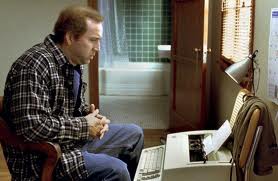 By Charles Harris The latest instalment of How to write your next script - click here for article 1 - The Seed Image In the last article of this series you finally read your first draft, with all the roller-coaster feelings that a first reading brings. It's now time to begin the second draft. If you've seen a lot that needs doing, this may seem daunting - the trick is to approach it step by step. Step by step Over many years of editing first drafts, I've learned not to try get it all right in one go. The only way that works for me is to take each element turn by turn. By focusing on just one element on each pass, you take an enormous amount of pressure off. So for the first edit, we focus solely on the structure. It doesn't matter, at this stage, how good or bad the dialogue is, whether the characters are consistent or the descriptions cinematic. That's all for future drafts. In short, what I call (to the outside world) a "second draft" will probably be made up of six or seven mini-drafts. For the first of these, I simply concern myself with whether the story is being told in the right order, at the right pace. It's far too unwieldy to do all this to the whole dialogue script, so my second draft is usually a short synopsis. It might be a short as one page or as long as five, but it shows me how the structure of a new draft might look in simple terms. The structure redraft 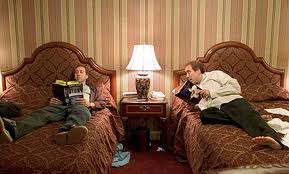 Now, there's a lot of hot air created about structure, especially three act structure. I'm not going to get into that, except to say that the big mistake is to think there is one "right" structure for every story. The job of the second draft is to find organically what structure your story needs, not to impose one.
In some cases, the right structure might indeed be three acts. Or it might be two acts (Full Metal Jacket), seven acts (Se7en), twelve episodes (Goodfellas), multistranded (Crash), flashback (Sunset Boulevard, The Usual Suspects, Pulp Fiction), circular (Tree of Life) or just about any permutation you can think of. However, whatever your story, certain structural needs will almost always be there. Questions, questions! So now ask yourself the following questions: 1. Does the story get going from the beginning? I guarantee that there will be numerous scenes at the start which are there to "set up" things that are coming later. The trouble is, an audience pays to watch a whole movie or TV drama - not just the bit that follows 45 minutes of "setting up". Set up scenes are boring. You have two choices. Ditch them now or ditch them later. (Guess which I recommend). Don't worry for the moment how the audience is going to know all that crucial stuff you want to tell them. Your aim is to get a story going from the very first half page. 2. Do the key moments happen when they should? No matter what your "act" structure, by page 10, the audience should begin to have an inkling of what the central issue is going to be. If not, they are going to get very twitchy. By page 30, the protagonist must have faced disaster and made a crucial decision that will lead to the rest of the plot. It can happen earlier, but any later and you'll have problems keeping your viewers watching. Around 20-30 pages from the end, we should have realised where the final resolution is going to take place and be on the edge of our seat waiting for it to happen. You can break those rules, but even the greatest writers rarely do. And when they do, they make sure they know why and how to get away with it. 3. If not, should I be cutting more scenes? Every first draft I ever see has far too much at the start and far too little at the end. (Including my own). The story starts around page 45. The big decision lurks on page 90. The final climax is squeezed onto the last five pages. It's time to get ruthless. If not, the people you try to sell your script to will be ruthless instead... Put those key moments where they are supposed to be. Cut the setting up scenes you were leaving till later. Now, with the space you've created, you can push your protagonist further than she thought she could ever go. Plan it out Now work your new structure into a brief outline to see if it works. Adjust as necessary. You've done your second draft. Easy, wasn't it. As long as you have a ruthless determination and very sharp pair of scissors! <Previous - How to read your script Next - Character> Charles Harris is an experienced award-winning writer-director for cinema and TV. His first professional script was optioned to be developed by major agents CAA in Hollywood and he has since worked with top names in the industry from James Stewart to Alexei Sayle. His books Complete Screenwriting Course and Jaws in Space: Powerful Pitching for Film & TV are recommended reading on MA courses. 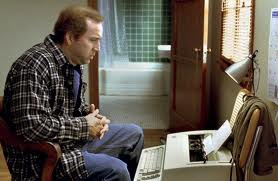 By Charles Harris
#5 in the series - Writing your next script - read the first article here In the previous article of this series on writing and editing your script for cinema or TV, I focused on writing the first draft. By now, if you've been following the process, you should have a pile of pages with a start and a finish and probably no idea whether they are good or bad. That's fine, the editing will help you find the gold among the clinker - starting with with the first reading. The naked truth The first reading is vital. It is the closest you'll ever get to seeing your script fresh - as others see it. It is also, almost certainly, the most painful. Here is your rough draft, naked and vulnerable, full of faults, ramblings and blind alleys. However, if you look carefully, here among the ashes of your hopes are a few jewels, perhaps more than you expected. A good line of dialogue. The makings of a strong scene. Approach it with the right attitude you'll put yourself in a perfect place to embark on draft number two. Time Your most important ally is time. Put the script aside for a few weeks or even months, to give yourself distance. Then clear a time when you know you can read straight through, undisturbed. Place This first draft reading should be done straight through without interruptions. You want to read it as if you were watching the movie. Turn off your live Facebook updates, feed the cats, jam a chair under the door handle. Whatever it takes. Medium If possible read your script in a different medium. If you write on screen, then print it out. Or borrow a friend's laptop. Anything to give yourself a new perspective. Notes Nothing should delay your reading - not even notes. Keep them very short. I find it best to read a print-out with a pen or pencil in my hand. Then I can make brief scribbles in the margin as I go. I've devised a rough code for myself.Ticks and crosses are obvious. A wavy line alongside a scene means it needs firm attention. A horizontal line tends to mean that the scene should have ended there. A variety of circles, ovals, arrows and squares each have their own subtle messages, depending on context. How you do it depends on you - but the important thing is to scribble fast and keep the reading flowing so you can maintain a sense of the overall flow of the script. What to watch for? At this stage, you want to be as open-minded as possible. Don't worry about details of style or even layout. They can be fixed later. Read first and foremost for the ebb and flow of the story. It won't be anything like right, but you'll catch glimpses of what it can (and perhaps will) become. Look also at the characters, especially your protagonist. Do we care about her? Does she seem like the kind of person we want to spend ninety or so minutes with? Can you see hints of the kind of fascinating person she might eventually become? Zero in on the good points that you can build on for the future. Be brave. In some ways it's harder first reading a first draft than writing it (if quicker). But you only have to do it once. Now you can start to plan how you're going to make it better. < Previous Next > Charles Harris is an award-winning writer-director for cinema and TV. His first professional script was optioned to be developed by major agents CAA in Hollywood and he has since worked with top names in the industry from James Stewart to Alexei Sayle. For an intensive three days on learning the secrets of professional screenwriting, join Charles at our unique ScreenPLAY Summer School - July 15-17 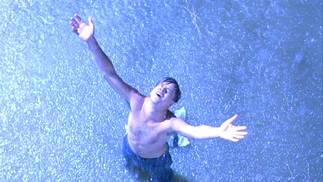 In the first three parts of this series on writing and editing your script for cinema or TV, I focused on your seed image, the premise and the outline treatment. Now it's time to write the first draft.
There are three important skills you need to conquer to be an effective first draft screenwriter. There's Technique, such as how to structure and how to write dialogue. This is the area covered by most of the books and workshops. Then there is Strategy. Knowing when and where to use those techniques. And finally there's your Mental Game. This is where you deal with your demons and get the work done. First draft writing is mostly about the Mental Game. The problem with most writers when they try to write their first draft is they start inventing rules that don't exist. Three Rules There only three rules for writing a first draft of anything. It must: 1. Start 2. Continue 3. Finish That's it. If you do those three things, if you've started - continued - finished - then you've successfully written a good first draft. Note that it doesn't need to be a fixed number of pages. It doesn't need to have three act structure or be laid out correctly or all those things you learn in Technique. That's what Second drafts are for. Bad is good The one thing you must not try to do with a first draft is to try to make it "good". Because you have two different parts to your brain - the creative brain and the critical brain. Both are essential but you simply can't use both at the same time. If you try to judge your work while you write it, you'll tie yourself in self-conscious knots. This is the best way to get writers' block. I've written scenes I thought were brilliant at the time and which turned out to be rubbish when I read through the following day. And I've written scenes I was sure were rubbish, and which remained unchanged all the way to the final draft. So, to write your first draft, just sit down and put some words on the page. Fast. Stephen King says he writes his first drafts "just fast enough that his fears can't catch up with him." You may indeed write rubbish - but that's OK. Nobody else need ever see it. If you try to make the draft "good" it will die on the page. Only if you give yourself permission to write badly will you discover a magic you can never find any other way. Of course you won't know it at the time. Trust your mental game You have to trust it's there - and you'll find it next time - when you start to edit. That's when you start to take the mess you've created and make it work. And that's for the future. Next: How to read a draft  Charles Harris
Scenes are the powerhouse of a screenplay - but too often they fail to grip their audience. This is due to a fundamental mistake that many writers make without realising. Conflict or dilemma? Everyone knows that a good scene needs external conflict - what most writers don't realise is that the external conflict is only half the story. At the heart of every good scene is a dilemma. A dilemma is essentially a situation in which your protagonist must make a choice between two equally bad alternatives. Without it your external conflict will remain superficial and uninvolving. Say, for example, your heroine is afraid of heights. She must save a child from falling to its death but can only do it by crawling onto a high ledge. Her inner dilemma draws us in. Either she stays safe, but loses the child, or she takes a risk and faces her worst fear. We want her to make the right decision - but at the same time we're afraid for her. Once she has made her choice, she is then plunged back into external conflict - lets say the ledge is slippery, the child difficult to grasp - which takes us to the next step in the story... and a new dilemma. Different stories This cycle of conflict and dilemma is by no means confined to high-tension action scenes, it comes into all kinds of scenes and genres. Take a recent episode of the legal drama series The Good Wife. Alicia Florrick's fledgling law firm has no money to pay for an assistant and so she's been relying increasingly on her teenage daughter, Grace. Grace willingly takes on a fight with their landlords but that leads to a dilemma when Alicia realises that her daughter is spending too much time on the company and sacrificing her own life. Alicia is faced with two bad options: jeopardise the firm or jeopardise her daughter's future. But she can't avoid the issue. She must make a decision and she must make it now. The choice she makes leads to her a fresh conflict - she has to confront Grace. Which in turn leads to a new dilemma. And so the cycle of dilemma and conflict continues... Your own scripts If written with energy and truth, alternating dilemma and conflict will always grip us. Now look at your own scripts. Whether planning, writing or editing, where could you bring out the dilemmas more clearly - or create them if they don't yet exist? Can you see how you could use the cycle of conflict/dilemma/conflict to strengthen your scenes? Was this tip useful? You can spend a day learning more scene-writing skills and turbo-boosting your scene-writing confidence at my workshop Creating Great Scenes in London on Saturday May 21st. When changing tastes and technical advances raise the bar on extreme imagery, what does this mean for narrative? Article by Ian Long Have you noticed cinema’s recent tendency to keep viewers locked onto extreme events for long periods of time? An incident that might once have functioned as a momentary shock is opened up, delved into, and transformed into what I’ve dubbed an “immersive catastrophe” - an event that plays out on a high note of terror, strangeness or personal threat for an extended duration, typically focusing on the experience of a single person. It’s interesting to speculate on the possibilities that this tendency opens up for narrative, and also what’s happening on an emotional level. Here's an example of an immersive catastrophe from the beginning of Hereafter (Clint Eastwood, 2008): 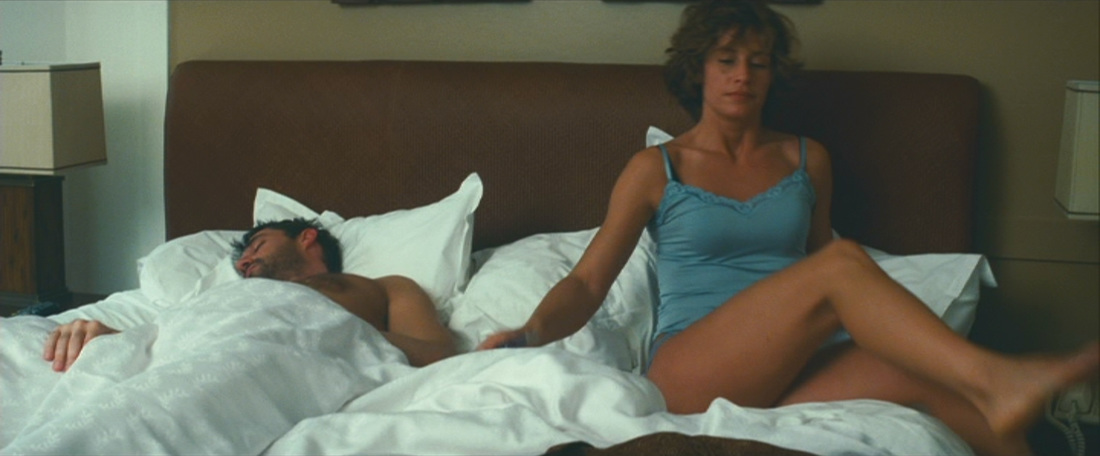 A couple awakes in a hotel room overlooking a tropical beach where people swim and frolic. 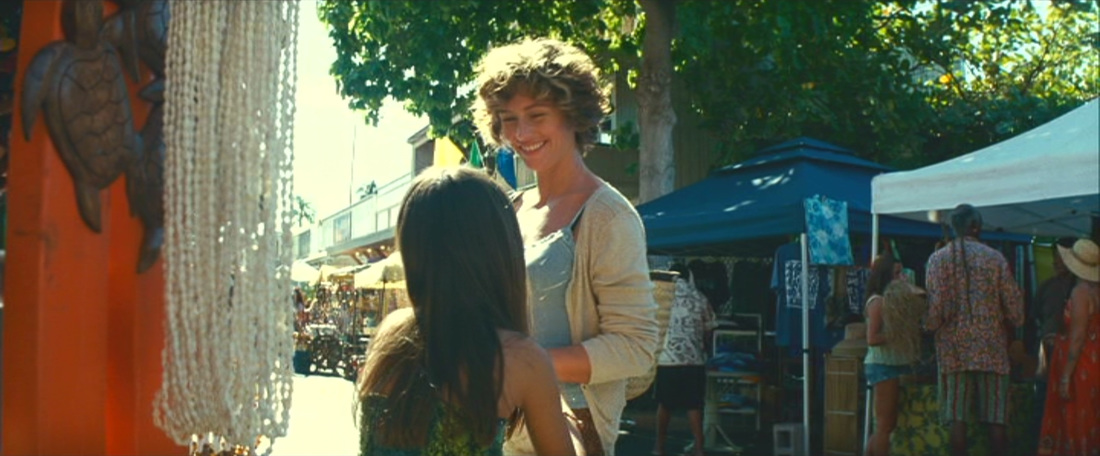 The woman leaves the hotel and browses some stalls in a crowded street, smiling and chatting with a young girl as she buys a bracelet. 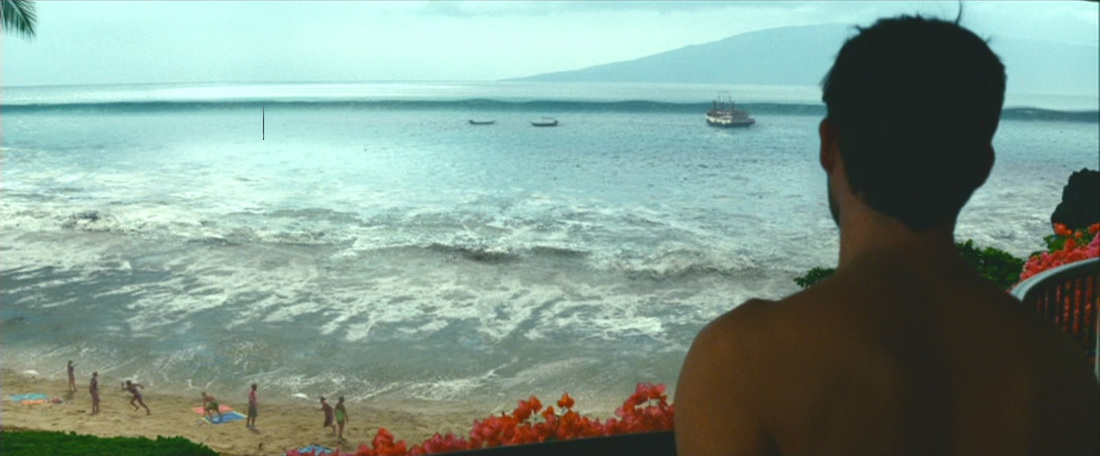 Meanwhile the woman's partner stands on his balcony, watching in disbelief as the sea draws away from the beach, then rushes back in the form of a huge tidal wave. 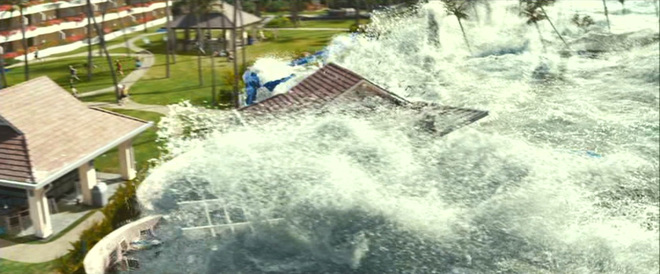 The wave smashes into the coast, uprooting trees and crushing buildings, and surges down the shopping street towards the woman. 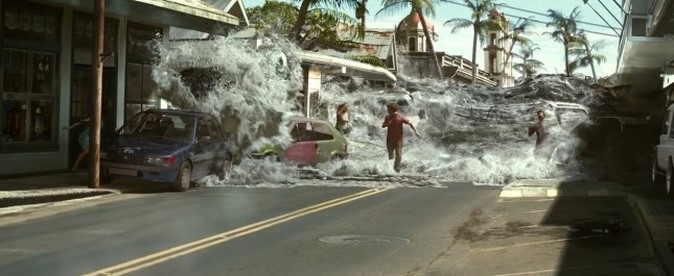 Holding the girl's hand, she tries to outpace the water; but it overwhelms them. 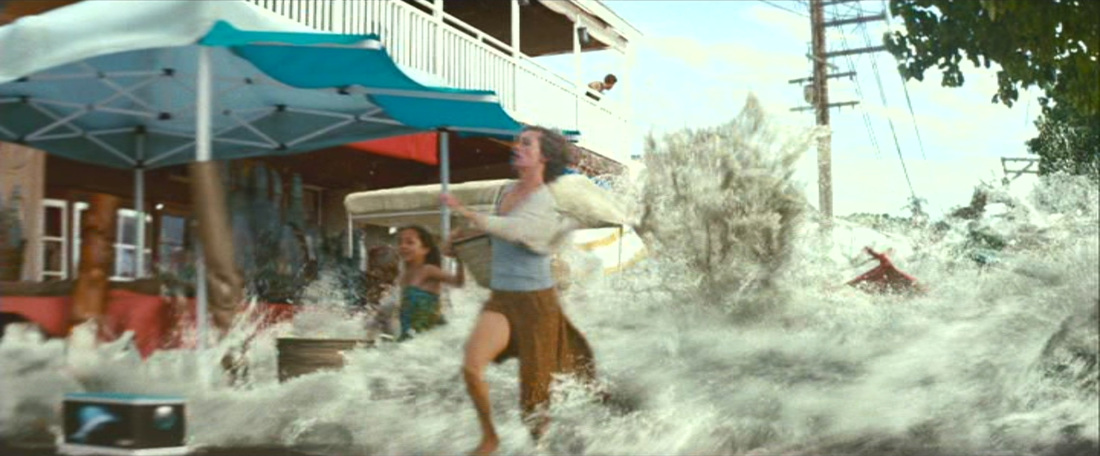 They’re borne along by a fast-flowing river full of cars, trees, and other debris. The woman loses hold of the girl. 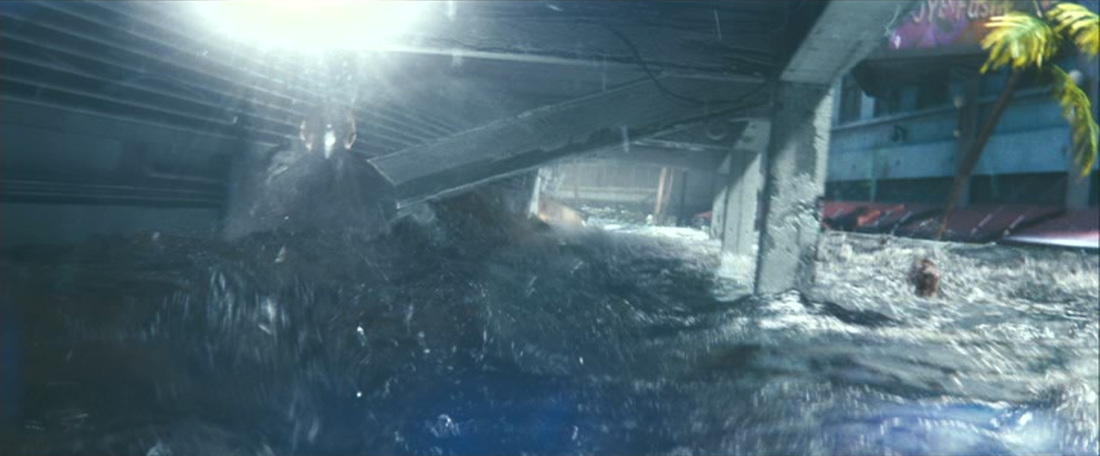 She’s rushed through the space beneath a wooden awning where electrical wires are shorting. 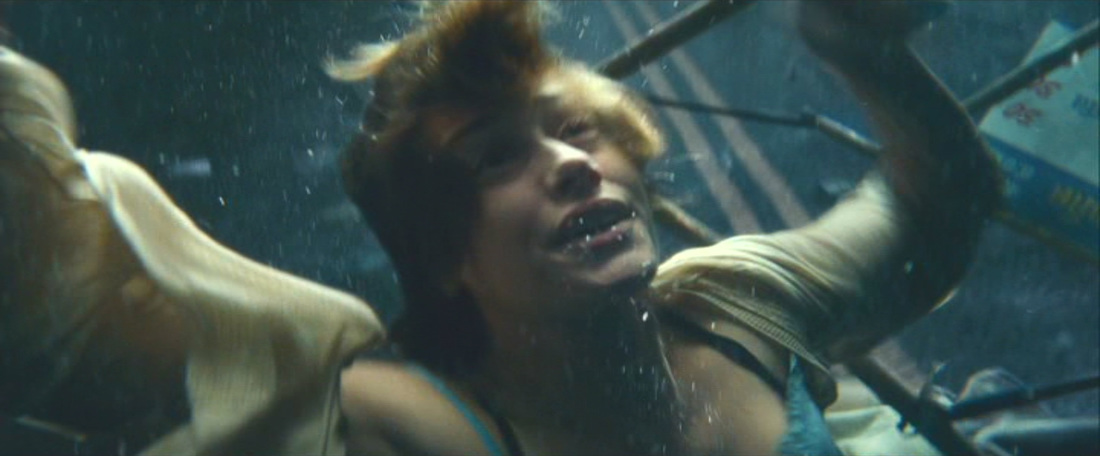 A vendor’s stall is hurled on top of her and pulls her to the bottom, but she fights free. 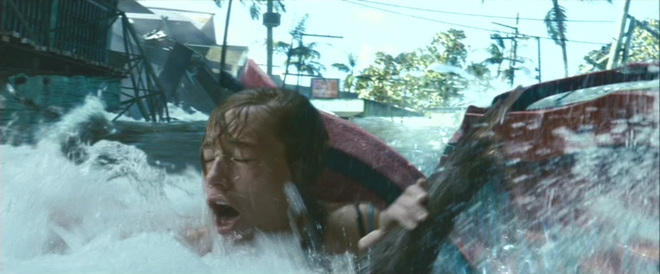 She’s slammed into a tree which has fallen into the road; grabs it; a man is poised to pull her to safety, then a car door hits her head and knocks her under the surface. 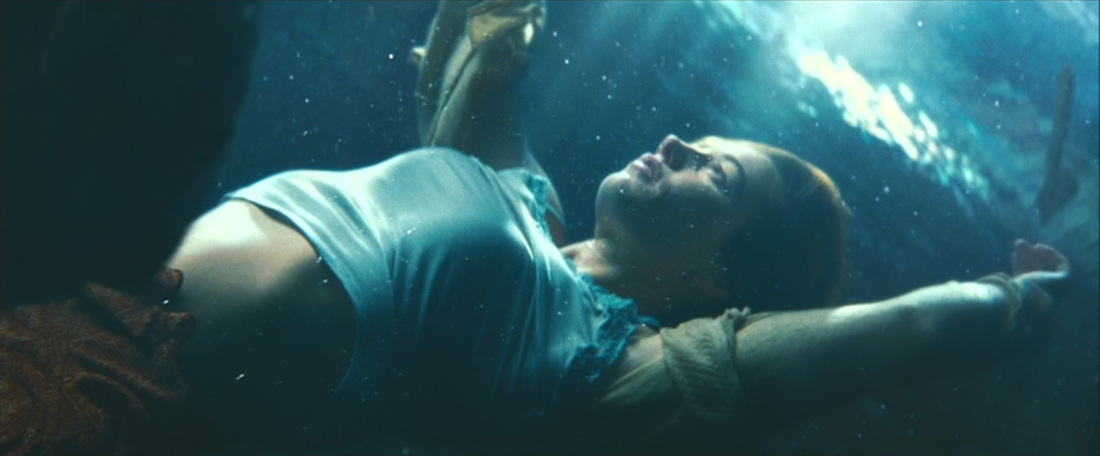 Heartbeats are heard as she floats unconscious, gazing unseeingly as debris floats above her. The bracelet falls from her fingers. Her face fills the screen, then a close-up of her left eye. 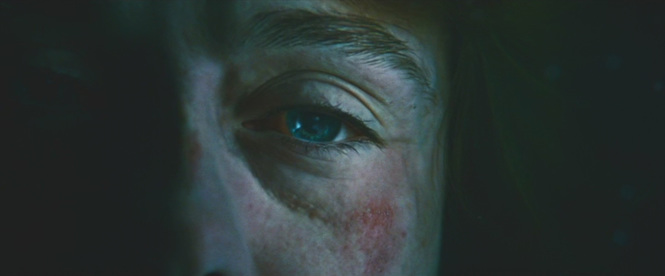 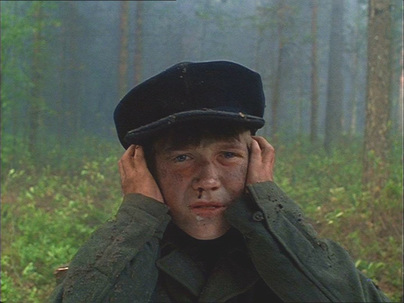 Boy soldier deafened in an air raid: Come and See (Elem Klimov) Boy soldier deafened in an air raid: Come and See (Elem Klimov) Cut to black. The heartbeats stop. Hereafter uses CGI, brilliantly in this case, to model the destructive power of water in an enclosed setting and to put us into the experience of someone who is caught up in it. The pace of events is shockingly fast, and we feel how it is to be in the power of something much stronger than ourselves. Who Uses The Immersive Catastrophe? Filmmakers from Steven Spielberg and Clint Eastwood to Gaspar Noé and Lars Von Trier have embraced it. In fact, the narratives of Noé’s films Enter the Void and Irréversible each constitute one long immersive catastrophe. The shower scene in Psycho is a precursor, but in its strong form the immersive catastrophe is something relatively new, enabled by the willingness of audiences (and censors) to accept ever more extreme imagery, and the technical ability to render such scenes with great realism. Does it represent film's acknowledgment of a new audience raised on ever-more-realistic first-person computer games - and the growing talk of a convincing virtual reality experience via systems like Oculus? Quite possibly. It’s probably also related to film’s need to differentiate itself from TV, and to give cinema audiences unforgettable, inimitable experiences. We can now be subjected at length to events that would once merely have been glimpsed or hinted at, or would have proved impossible to put on the screen realistically. But what does the immersive catastrophe do? 1) It lets us share a character’s shock at the abrupt onset of a frightening event. 2) It obliges us to inhabit their experience, rather than simply watching it, as the event plays out. We tend to remain inside a character’s experience, on a very visceral level. 3) It gives us very strong visual and emotional content, and a turnover of heightened images and sensations, often of an extreme or taboo nature. 4) These incidents may occur so rapidly that they’re hard to process; or they may show us a single thing happening in great, slowed-down detail. 4) Typically, it exceeds our expectations. And this happens, even in a negative way, there can be an exhilarating element to the experience. The sheer momentum of Hereafter’s opening scene has elements of the carnival ride, for instance. 5) It glues us to the screen, grabbing our attention and heightening our responses to the larger narrative as it unfolds. 6) It burns itself onto our memory. If we’ve had a peak experience, good or bad, we’ll remember the film in which it occurred. 7) It throws everything around it into sharp relief. What is the meaning of a world that can contain this event? How does the rest of the story measure up to it? 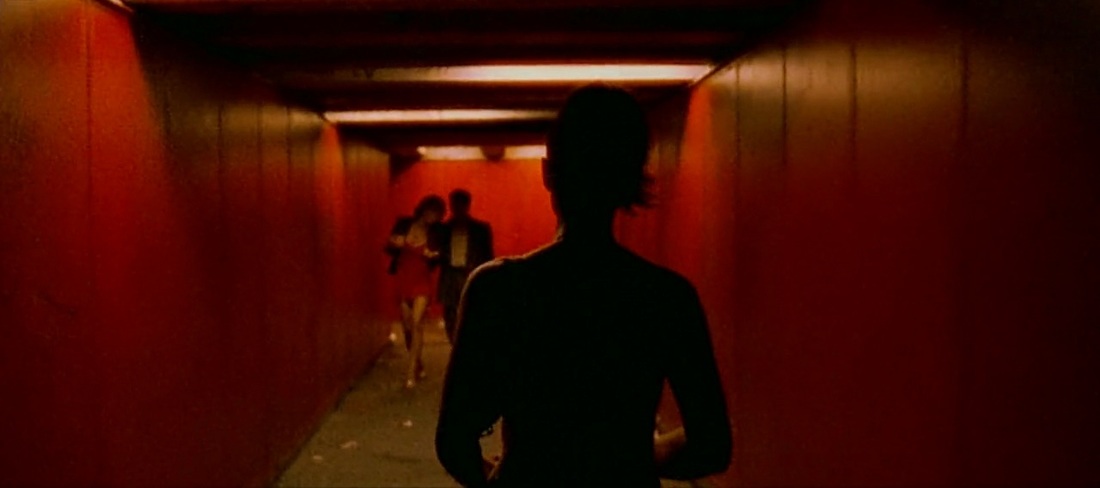 A personal/emotional catastrophe: Gaspar Noe's Irréversible What Form Do They Take? The nature of a “shock moment” changes, taking on new meanings, when it doesn’t stop but carries on … and on … and on. Through its brutality and sheer duration, for instance, the rape scene in Irréversible becomes a personal and emotional catastrophe not just for Alex, the woman who has been assaulted, but also for the audience. Its impact just wouldn't be the same if it had been shorter. By being forced to experience the event in real time, we too feel trapped, overwhelmed, subject to a malign will that can't be reasoned with. Our nerves are stretched to breaking point. Irréversible also demonstrates that immersive catastrophes needn’t always play out on a large scale, with the aid of special effects. As with Hereafter, a “grammar” has to be found to structure the mini-narrative of the immersive catastrophe. When a single event is stretched out, it inevitably becomes a series of smaller events - bound together by the unities of time and action. 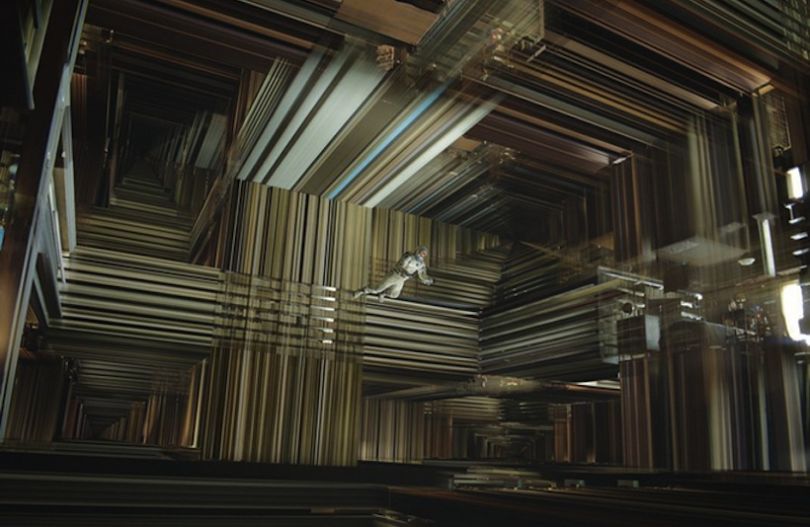 Immersive catastrophe in Sci-Fi: the disturbing "five-dimensional space" scene in Christopher Nolan's Interstellar Positioning in the Narrative
The immersive catastrophe also takes on very different meanings depending on its position in the narrative. Catastrophic events usually spell endings. The play Journey’s End by R. C. Sherriff ends with the cataclysmic death of all the characters we’ve seen, bringing home the fragility – close to meaninglessness - of individual histories in war. However, an extreme, “everything is over” scene at the beginning of a film can mark its seriousness of intent. If stories dealing with war and other kinds of inhumanity are going to be truthful to their subject, shouldn’t they be brutally honest from the outset? An “ending event” in the middle of a film (Psycho, Irréversible) inevitably serves as a fulcrum for the narrative, a “game-changer” which throws the audience and may even alter their sense of the genre of the story they’re watching. Many would argue that terrors evoked in viewer’s minds are still more powerful than anything we actually see, no matter how catastrophic – but filmmakers now have the licence to explore a different, more bruising and arduous kind of fear, and they need to think about how it works. Creating Fear in Films workshop - April 16 We'll be looking further into these and many other ideas, and the deep psychology of fear in all kinds of cinema, in our workshop in Central London on April 16. Places are very limited, so book now to avoid disappointment! You can find out more here. |
BLOGTHE ONLY PLACE TO TALK ABOUT THE CRAFT OF SCRIPTWRITING. Archives
November 2023
|
 RSS Feed

|

|

|
Privacy Policy © Euroscript Limited 2020